Tài Xỉu MD5 Results – From Hash Codes to the Final Outcome
With taixiumd5 results can seem mysterious when players first encounter hash codes and the numbers shown after each round. Understanding how the displayed code connects with the final outcome makes the process easier to follow. Rather than treating the result as a hidden prediction tool, readers can look at the basic mechanics and see how the information is presented.

Can You Decode an MD5 Hash to See the Result Early?
Can You Decode an MD5 Hash to See the Result Early?
An MD5 hash may look like a coded message, but it is not an ordinary encryption format that can simply be decoded to reveal hidden text. In result-based systems, the displayed hash may represent processed data rather than a readable preview of a future outcome.
Hashes Work Differently
MD5 is a hashing algorithm that converts input data into a fixed 128-bit digest, commonly shown as 32 hexadecimal characters. Unlike encryption, hashing is designed as a one-way transformation. The visible string does not provide a straightforward method for recovering the original input or reading a future result directly.
No Early Decoding
A hash cannot normally be reversed to reveal an unknown result before the relevant data has been determined. Testing possible inputs may reproduce a known hash, but that is different from predicting an undisclosed value. Without the required input or process details, the hash alone does not expose a guaranteed early outcome.
Hash Output Limits
The characters inside an MD5 string represent the calculated digest of specific input data. Similar-looking characters do not necessarily indicate similar results, and repeated sequences should not be interpreted as clues to what comes next. The output is better understood as a data fingerprint than a readable prediction.
Fair Systems Matter
If a game uses a hash as part of a verification or fairness mechanism, the purpose may be to show that information was generated according to a defined process. The hash itself does not automatically prove that a result can be known beforehand. Users should review the system’s published explanation to understand its actual role.
Avoid False Claims
Websites or individuals claiming they can reliably decode an MD5 hash to reveal an upcoming result deserve caution. Such promises may confuse hashing with encryption or use technical language to create a false impression of certainty. Users should avoid paying for supposed prediction tools based solely on an MD5 string.
Why MD5 Hashes Are Used for Result Verification Online
MD5 hashes can appear in online verification systems as a way to represent information in a compact format. Instead of displaying the original data immediately, a platform may publish a hash first and reveal related information later. Understanding the purpose of hashing helps users see how such systems can support transparency without treating a hash as a prediction tool.
Hashes Hide Data
A hash transforms input data into a fixed-length string that does not directly display the original content. In a verification setting, this can allow information to remain undisclosed until the appropriate stage. The later data can then be processed through the same hashing method for comparison, depending on how the system is designed.
Verification Uses Matching
The basic idea behind hash verification is comparison. If the same input produces the same hash under the same method, the resulting strings should match. This can help users check whether information has remained consistent between two stages. The platform’s published procedure is important for understanding exactly what is being verified.
MD5 Has Limitations
MD5 is an older hashing algorithm and is no longer considered suitable for many modern security applications because researchers have demonstrated practical collision weaknesses. A collision means different inputs can be constructed to produce the same hash. For simple integrity-style checks, MD5 may still appear in legacy systems, but it should not be treated as a strong modern security mechanism.
Transparency Builds Trust
A verification mechanism can give users more information about how a result was recorded or generated. Clear documentation allows people to understand what data is committed, when it is revealed, and how the comparison works. Transparency is strongest when the process is explained openly rather than relying on technical terms alone.
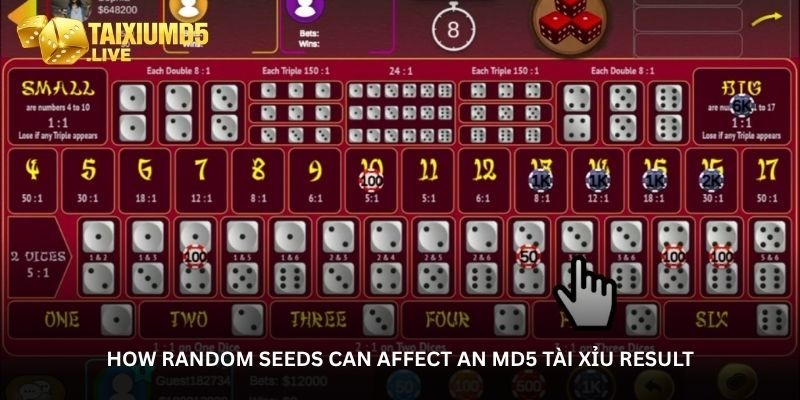
How Random Seeds Can Affect an MD5 Tài Xỉu Result
How Random Seeds Can Affect an MD5 Tài Xỉu Result
Random seeds can play a role in systems that use hashing to generate or verify game outcomes. An MD5 hash does not create randomness by itself; it transforms input data into a fixed string. The final result depends on how the platform combines the seed, game rules, and other inputs before producing the outcome.
Understand Random Seeds
A random seed is an input value used by a system when generating a result. It may be created before a round or combined with another value during processing. Changing the seed changes the resulting hash, so two rounds using different inputs will normally produce different MD5 strings.
Combine Multiple Inputs
Some systems may combine a server-side seed with a client-side value, nonce, or round identifier. The exact structure depends on the platform’s implementation. Once these inputs are processed through MD5, even a small change can produce a substantially different hash, making the original input difficult to infer from the output alone.
Hash Output Changes
MD5 produces a 128-bit hash, commonly displayed as a 32-character hexadecimal string. If the seed or any other input changes, the resulting hash will also change. The hash therefore acts as a compact representation of the supplied data rather than a visible sequence that directly explains the final game result.
Result Rules Matter
A hash value alone does not determine whether a round becomes Tài or Xỉu. The platform needs a defined method for converting the processed data into a game outcome. That method might involve numerical conversion, specific characters, or another formula, so users should check the published rules instead of guessing from the MD5 string.
Conclusion
Hash codes may add a technical layer to the game, but they do not turn past results into a reliable forecast. Players should focus on understanding how outcomes are displayed and avoid assuming that a sequence guarantees what comes next. Before choosing to nap tiền tài xỉu md5, check the rules and payment conditions, then stay within a sensible budget.
